A developer broke ground on a mixed-use tower near Journal Square, expecting routine conditions. Within the first twenty feet, the auger hit a pocket of uncompacted urban fill mixed with estuarine silt. That discovery shifted the entire foundation concept from shallow footings to a deep pile system. Jersey City’s subsurface packs 400 years of surprises—reclaimed marshland, buried timber bulkheads, and variable water levels tied to the Hudson River. A soil mechanics study is what separates a realistic construction budget from a schedule of costly change orders. By quantifying compressibility, shear strength, and consolidation behavior in the laboratory, the engineer can match the structural demand to the actual bearing strata. For projects near the waterfront, where soil profiles change block by block, we often recommend pairing the laboratory program with a CPT test to map stratigraphic continuity before sampling begins.
In Jersey City, a soil mechanics study built on lab-measured pore pressure parameters predicts settlement years before the first crack appears in the drywall.
Service characteristics in Jersey City
Critical ground factors in Jersey City
The biggest technical risk we observe in Jersey City is assuming that fill is uniform. Old maps show creeks that were piped and covered with debris, creating pockets where the Standard Penetration Test refusal jumps from five blows to fifty within a ten-foot lateral distance. Differential settlement across these transitions will crack slabs and rack door frames if the structural engineer doesn't have a detailed cross-section from the lab program. A second risk is liquefaction in the loose saturated sands found near the Hackensack River; a soil mechanics study that includes cyclic triaxial testing or at minimum fines content and plasticity index can screen this hazard without over-conservative ground improvement. The third risk is chemical attack on concrete: urban fill often contains elevated sulfates, and groundwater with low pH can degrade standard Portland cement. Testing pH, sulfate content, and resistivity during the lab phase protects the foundation concrete specification before the pour.
Our services
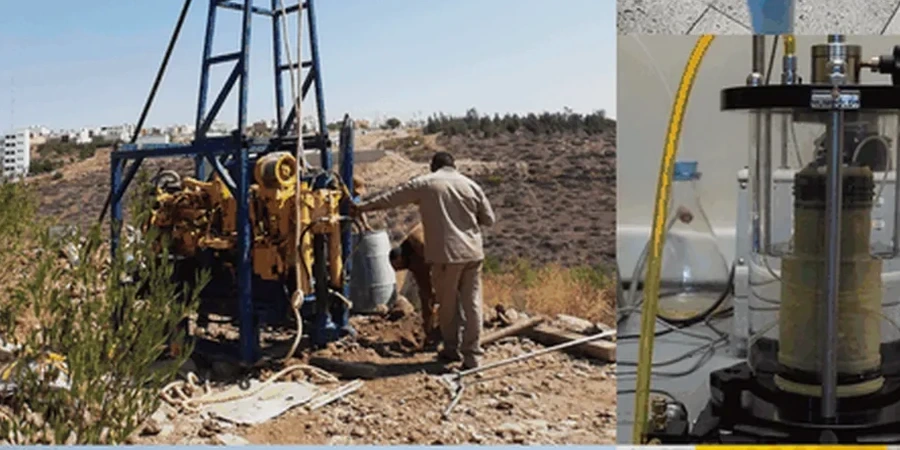
The laboratory testing program we coordinate in Jersey City translates field samples into engineering parameters that govern foundation selection and earthwork specifications.
Index and Classification Testing
Water content, Atterberg limits, and grain size distribution per ASTM D4318 and D6913 to classify the varved clays and glacial outwash common across Hudson County.
Strength and Compressibility
Triaxial compression (CU and CD) and oedometer consolidation tests to define the drained friction angle and compression index for the organic silts beneath the city's historic fill.
Chemical and Durability Analysis
Sulfate, chloride, pH, and resistivity testing on soil and groundwater samples to specify the correct concrete exposure class for foundations in brownfield redevelopment zones.
Common questions
How much does a soil mechanics study cost in Jersey City?
A complete laboratory program tied to a geotechnical investigation in Jersey City typically ranges from US$3,430 to US$4,930, depending on the number of samples, the suite of tests required (consolidation, triaxial, direct shear), and the turnaround time needed for the permit submission.
How long does it take to get the lab results back?
Standard index tests can be reported in three to five business days. Consolidation and triaxial tests require longer curing and shearing phases, so a complete soil mechanics study package usually takes two to three weeks from the date the samples arrive at the laboratory.
What test determines if the soil will settle under my building?
The one-dimensional consolidation test (ASTM D2435) measures the compression index and the preconsolidation pressure of the clay. For Jersey City's organic estuarine deposits, this test is essential to calculate the magnitude and rate of settlement under the proposed foundation load.
Do you need a soil mechanics study for a retaining wall design?
Yes. The lateral earth pressure coefficients used in retaining wall design depend on the drained friction angle and the soil-wall interface friction, both of which come from direct shear or triaxial testing. Without lab-measured values, the designer must use conservative default parameters that often lead to a heavier, more expensive wall.
Does the soil mechanics study include a seismic site class determination?
Yes. We derive the seismic site class (A through F) per IBC and ASCE 7 by combining the Standard Penetration Test N-values, the undrained shear strength from lab testing, and the shear wave velocity profile where available. Jersey City projects near the Palisades often classify as Site C or B, while the lowlands near the Hackensack typically fall into Site D or E.