Jersey City sits on ground that shifts between dense glacial till and soft estuarine clay, often within the same city block. At 40.7216° north, the geology transitions from the basalt ridge of the Palisades down to former marshland fill along the Hudson—and that contrast means a footing design that works near Journal Square may completely fail at a site three blocks east. A triaxial test gives engineers the drained and undrained shear strength values needed to size foundations, retaining structures, and deep excavations correctly. Our laboratory runs ASTM D4767 consolidated-undrained and ASTM D2850 unconsolidated-undrained procedures on undisturbed Shelby tube samples taken directly from project borings across Hudson County. We track saturation, back-pressure, and pore pressure response throughout each stage so the effective stress parameters—c' and φ'—reflect actual in-situ behavior, not idealized textbook curves.
Effective stress parameters from a properly saturated triaxial test change the factor of safety calculation by 30 percent or more compared to empirical correlations alone.
Service characteristics in Jersey City
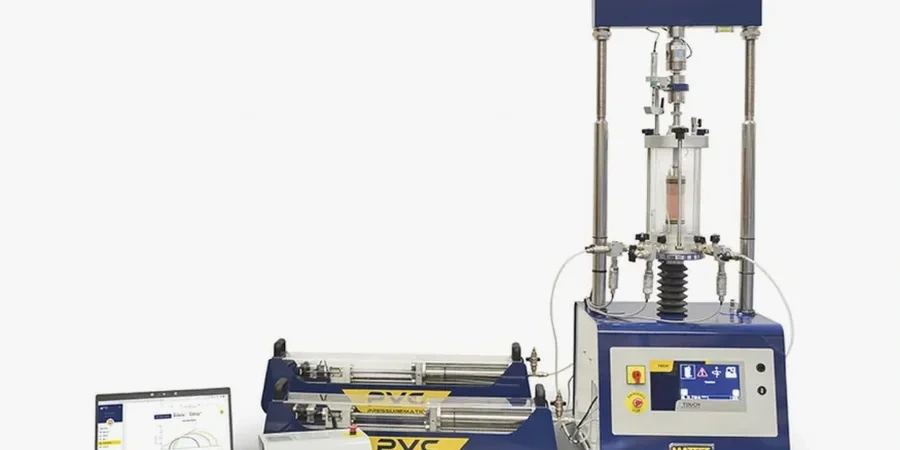
Critical ground factors in Jersey City
The biggest geotechnical risk in Jersey City is not settlement alone: it is shear failure in normally consolidated organic silts that underlie much of the waterfront redevelopment zone. These soils lost strength during the 2011 Virginia earthquake felt across the metro area, and even a minor seismic event can trigger a pore pressure spike that drops effective stress to zero in a matter of seconds. Contractors who skip triaxial testing on these deposits are designing blind to the undrained strength ratio Su/σ'v, which governs whether a slope, excavation wall, or tower crane pad will hold up during construction. A CPT test can map the stratigraphy quickly, but it cannot give you the Mohr-Coulomb envelope or the critical state friction angle—only a triaxial cell with proper saturation and strain-rate control delivers that. On sites within the 100-year floodplain, we also run multi-stage tests to capture strength loss under repeated loading cycles that simulate storm surge and tidal fluctuation.
Our services
Our triaxial testing program is designed around the soil conditions actually encountered in Hudson County, with specimen preparation and saturation protocols matched to each formation.
CU Triaxial with Pore Pressure Measurement
Consolidated-undrained test on cohesive soils per ASTM D4767. Includes back-pressure saturation to B ≥ 0.95, K0 or isotropic consolidation to in-situ stress, and strain-controlled shear at 0.5–2%/hr with continuous pore pressure logging. Delivers c' and φ' for effective stress stability analysis.
CD Triaxial for Granular Soils
Consolidated-drained test on sands and silty sands per ASTM D7181. Specimens are reconstituted to field density from undisturbed samples or SPT split-spoon material. Drainage is verified via pore pressure dissipation; shear rate is slow enough to prevent excess pore pressure buildup. Delivers drained friction angle for bearing capacity and retaining wall design.
Multi-Stage Triaxial for Limited Samples
When only one Shelby tube is available, a multi-stage CU test applies increasing confining pressures to a single specimen. Each stage shears to just beyond peak before unloading, then reconsolidates at higher pressure. Delivers a Mohr-Coulomb envelope from one specimen, reducing field sampling cost on small Jersey City infill lots.
Common questions
What does a triaxial test cost for a Jersey City project?
A standard ASTM D4767 CU triaxial with pore pressure measurement runs between US$1,870 and US$2,540 per specimen, depending on the number of consolidation stages and whether multi-stage loading is required. Projects needing both CU and CD triaxials on the same formation typically fall in the upper portion of that range. We provide a firm quote once we review the boring logs and know how many specimens meet the undisturbed-sample criteria.
How long does a consolidated-undrained triaxial test take?
A single CU triaxial test typically requires five to seven working days from specimen trimming to final data reduction. Saturation alone can take 24–48 hours for low-permeability clays from the Hudson waterfront. Consolidation time depends on the drainage path length and coefficient of consolidation; we monitor volume change until primary consolidation is complete per ASTM D4767 criteria before starting the shear stage.
What sample quality do you need for a reliable triaxial test?
We require undisturbed Shelby tube samples (ASTM D1587) with a recovery ratio of at least 90 percent and no visible disturbance, cracking, or desiccation. Samples must be sealed with wax or end caps immediately in the field and transported upright in cushioned carriers. For granular soils that cannot be sampled undisturbed, we prepare reconstituted specimens at the field density and moisture content reported on the boring log.
Can a triaxial test replace other shear strength tests on my project?
The triaxial test provides the most complete shear strength envelope (c', φ', stress path, and pore pressure response), and for critical structures it is the reference method. However, for preliminary site characterization or projects with many borings, we often combine triaxial testing on key specimens with direct shear or unconfined compression on the remaining samples to control cost while still anchoring the strength parameters to laboratory-measured values.