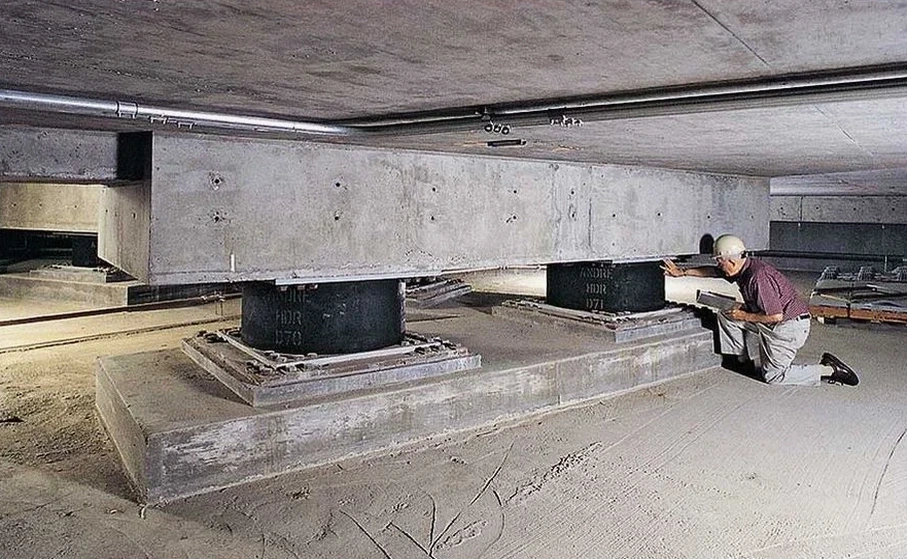
Jersey City isn't uniform ground. Downtown near the waterfront sits on thick layers of glacial silt and man-made fill, while Journal Square and the Heights transition into denser glacial till and shallow bedrock. That contrast matters when a building shakes. A 10-story structure on Montgomery Street behaves differently than one on Palisade Avenue during a seismic event. We see this in every project across Hudson County. Base isolation seismic design addresses these differences at the foundation level. Instead of forcing a building to resist earthquake forces, we insert flexible isolation devices between the structure and its foundation. The building moves less. Damage drops. For Jersey City's mixed soil profiles—from the soft clays near Exchange Place to the compacted till under McGinley Square—this approach often outperforms conventional fixed-base design. We combine site-specific seismic microzonation with isolation system modeling to match the real ground conditions, not generic assumptions.
A properly isolated building in Jersey City can reduce seismic forces by 60 to 80 percent compared to a fixed-base design—less structural damage, fewer business interruptions.
Service characteristics in Jersey City
Working video
Critical ground factors in Jersey City
A 15-story residential tower on Washington Boulevard went through value engineering a few years back. The developer considered dropping the base isolation system to cut initial costs. We ran the numbers. Under a 475-year return period event on Jersey City's Site Class E soils, the fixed-base design showed interstory drift ratios exceeding 2.5 percent. That means cracked partitions. Buckled cladding. Elevators out of service for months. The isolated design kept drift under 0.8 percent. The premium for isolation was less than 4 percent of total structural cost. The developer kept the system. Jersey City sits close enough to the Ramapo Fault zone and far-field sources to justify the analysis. A liquefaction assessment near the waterfront adds another layer—if the soil loses strength, the isolators still function as long as the foundation slab remains intact. Skipping the seismic isolation conversation on a project over six stories in this city is a risk most owners can't afford.
Our services
Our base isolation engineering in Jersey City covers the full project lifecycle. We work directly with structural engineers and contractors from schematic design through construction administration.
Isolation System Feasibility & Peer Review
We evaluate whether your project site in Jersey City—given soil conditions, building height, and occupancy type—benefits from isolation. Includes cost-benefit analysis and preliminary isolator selection.
Nonlinear Time-History Analysis & Design
Full 3D modeling of the isolated structure under site-specific ground motions. We generate isolator properties, displacement demands, and superstructure force distributions per ASCE 7 Chapter 17.
Construction Support & Isolator Testing Oversight
On-site verification of isolator installation, moat construction inspection, and witnessing of prototype and production tests at the manufacturer's facility before shipping to Jersey City.
Common questions
What does base isolation design cost for a building in Jersey City?
For a typical mid-rise project in Hudson County, the engineering design and analysis portion of base isolation work ranges from US$4.080 to US$7.580. The isolator hardware and installation are separate costs that depend on building weight and the number of units required. We provide a detailed scope breakdown before any commitment.
Does Jersey City require base isolation by code?
No. The IBC and ASCE 7 do not mandate base isolation for any occupancy type. It's a performance-based design option. However, for essential facilities—hospitals, emergency response centers, data centers—where post-earthquake functionality is critical, isolation often becomes the most cost-effective path to meeting continuity of operations requirements.
How do isolated buildings handle Jersey City's soft waterfront soils?
The isolation system sits on a rigid foundation slab that bridges softer zones. We design the slab and any supporting deep foundations—often driven piles through the fill—to remain elastic under isolator bearing loads. The isolators themselves don't care about the soil; they care about the slab's stability. A separate geotechnical investigation, including consolidation testing of the organic silts common near the Hudson, confirms long-term settlement is within tolerable limits.
Can an existing Jersey City building be retrofitted with seismic isolation?
Yes, but it's complex. We've done retrofit studies for unreinforced masonry buildings in the downtown historic district. The process involves temporarily shoring the structure, cutting columns at the foundation level, and inserting isolators with jacking systems. It's expensive and disruptive, but for historically significant structures where demolition isn't an option, it's a proven technique.