Jersey City sits on a complex mix of glacial outwash, varved clays, and estuarine silts deposited by the Hudson River, where the groundwater table often sits less than 10 feet below grade in areas like Downtown and Journal Square. When a boring brings up gray, cohesive material from 15 feet down, the first question the geotechnical engineer asks is about its plasticity. The Atterberg limits define the moisture contents where that soil transitions from semisolid to plastic to liquid behavior, and those numbers directly control settlement predictions and bearing capacity calculations under the 2018 New York City Building Code amendments that influence design across the Hudson waterfront. Our laboratory runs the liquid limit, plastic limit, and plasticity index on every bulk sample from sites across the city, providing the USCS classification that determines whether that clay is lean (CL) or fat (CH) and what that means for the foundation system above it.
The Atterberg limits are not just index numbers: on Jersey City’s varved clays, the liquidity index calculated from natural water content and Atterberg data often reveals a soil closer to failure than the SPT blow count suggests.
Service characteristics in Jersey City
Working video
Critical ground factors in Jersey City
Jersey City’s development history, from 19th-century brownstones on shallow rubble footings to the steel-framed towers now rising along the waterfront, means that almost every site has some legacy fill over natural deposits. The real risk shows up when Atterberg data is skipped and a designer assumes that “clay” is “clay.” We have seen projects in the Bergen-Lafayette area where the liquid limit varied from 45 to 75 within the same boring, indicating interbedded lean and fat clays with completely different consolidation characteristics. Without that number, the predicted settlement under a mat foundation can be off by inches. The IBC and ASCE 7 references require soil properties based on laboratory testing, not field logging alone, and an Atterberg test is the minimum defensible basis for classifying cohesive strata. When the plasticity index comes back above 35 on a sample from near the Hackensack River, the responsible engineer knows to check shrink-swell potential and to consider whether a stone columns ground improvement program makes sense before placing structural loads on that profile.
Our services
The Atterberg limits are one part of a complete laboratory testing program. For Jersey City projects, we typically pair plasticity data with these complementary services:
Full USCS Classification Package
Combines Atterberg limits with sieve and hydrometer analysis to produce the complete group symbol and group name per ASTM D2487, giving the design team the exact soil description required for geotechnical reports filed with the Jersey City Building Department.
Natural Water Content & Liquidity Index
We measure the in-situ moisture content on every Atterberg sample and calculate the liquidity index (LI) when the plastic and liquid limits are known. An LI approaching 1.0 on Jersey City clays is a red flag for sensitivity and potential strength loss during construction.
Shrink-Swell Assessment
For sites with high-plasticity clays (CH), we run the linear shrinkage test and provide activity values (PI divided by clay fraction) so the structural engineer can evaluate whether the soil will heave under changing moisture conditions, a concern near the Meadowlands boundary where water tables fluctuate seasonally.
Common questions
How much does Atterberg limits testing cost for a Jersey City project?
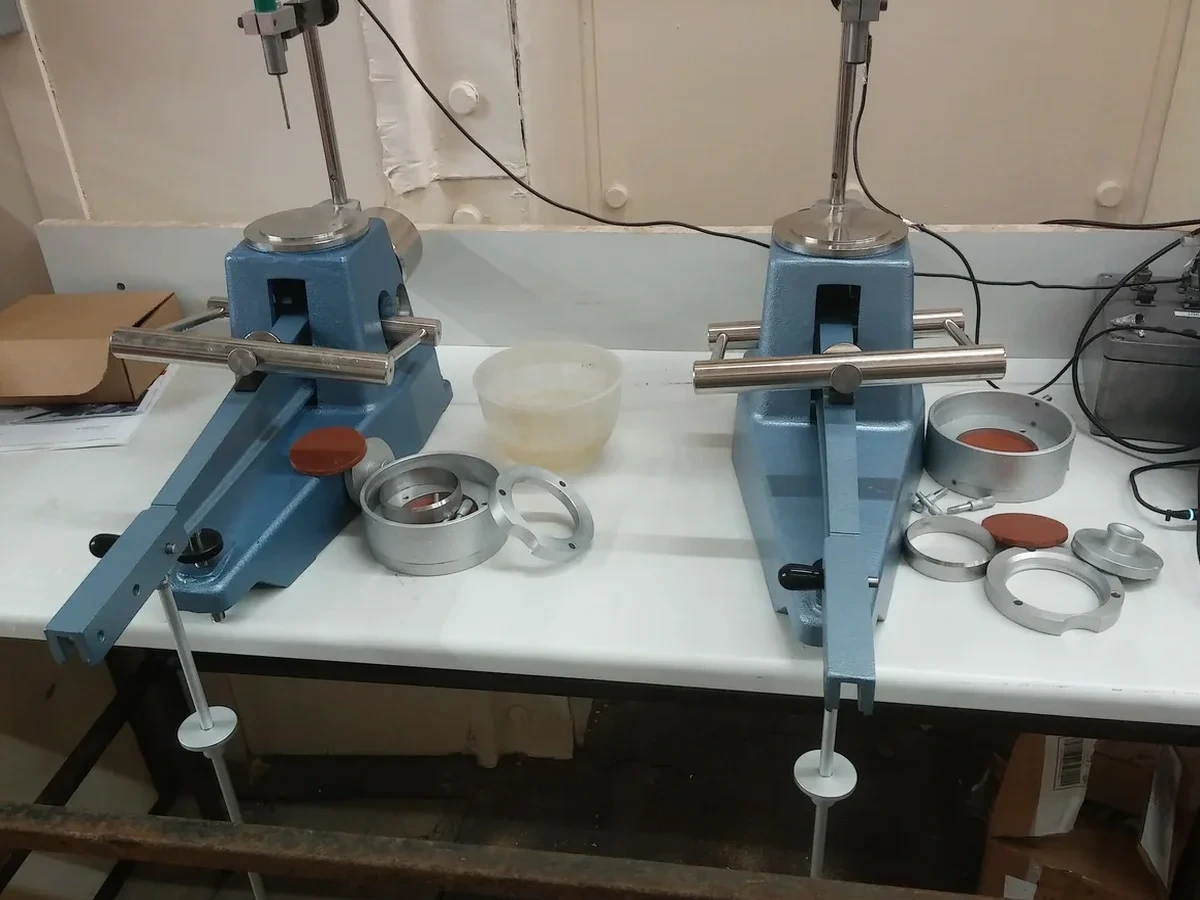
For standard Atterberg limits testing (liquid limit by multipoint method and plastic limit) per ASTM D4318, the cost ranges from US$70 to US$110 per sample depending on the number of samples in the batch and whether we also run the natural water content and hydrometer analysis. We provide a single-price proposal that includes sample pickup from your Jersey City site, so there are no hidden logistics charges.
How long does it take to get Atterberg limits results?
ASTM D4318 requires a minimum 16-hour hydration period for wet-prepared samples, so the absolute fastest turnaround is about 2 working days. For most Jersey City projects, we quote 3 to 4 business days from sample receipt to PDF report delivery, and we can expedite to 2 days for an additional rush fee when the contractor needs numbers to finalize a foundation submittal.
Do you test samples from Jersey City sites or do we need to send them to a remote lab?
We coordinate sample pickup directly from your drill rig or site trailer anywhere in Jersey City, from the waterfront to the Heights, usually the same day the borings are completed. The testing is performed in our laboratory, and you receive the signed, QA-reviewed report by email. There is no need to ship samples out of the area, which saves time and preserves sample integrity.
What is the difference between single-point and multipoint liquid limit testing?
The single-point method estimates the liquid limit from one blow count and assumes a standard slope for the flow curve. On Jersey City’s varved clays and organic silts, that assumption frequently fails and produces a liquid limit that is 4 to 8 points off from the true multipoint value. We run the full multipoint method (3 to 5 data points) per ASTM D4318 Section 12, which is the only approach accepted for geotechnical baseline reports and foundation design submittals under IBC requirements.