Jersey City's building code enforces Chapter 18 of the IBC alongside ASCE 7-22 for deep foundations, and for good reason. Much of the city sits on historic fill, meadow mat, and estuarine deposits that don't provide the bearing capacity a shallow foundation demands. When you're developing in Paulus Hook or along the Hackensack riverfront, the design has to account for a groundwater table that sits barely 4 to 6 feet below grade. The pile foundation design we deliver starts with that reality, not a textbook assumption. We match the pile type to the subsurface profile, whether that means driven H-piles through demolition debris or drilled shafts socketed into the weathered Brunswick shale that underlies the city's western edge. Before committing to a pile layout, many project teams run an SPT drilling campaign to establish refusal depths across the site, which directly feeds the axial capacity calculations and helps avoid costly change orders mid-construction.
A pile in Jersey City isn't just a structural element; it's the interface between your building and a century of urban fill that demands a design grounded in actual site data, not regional averages.
Service characteristics in Jersey City
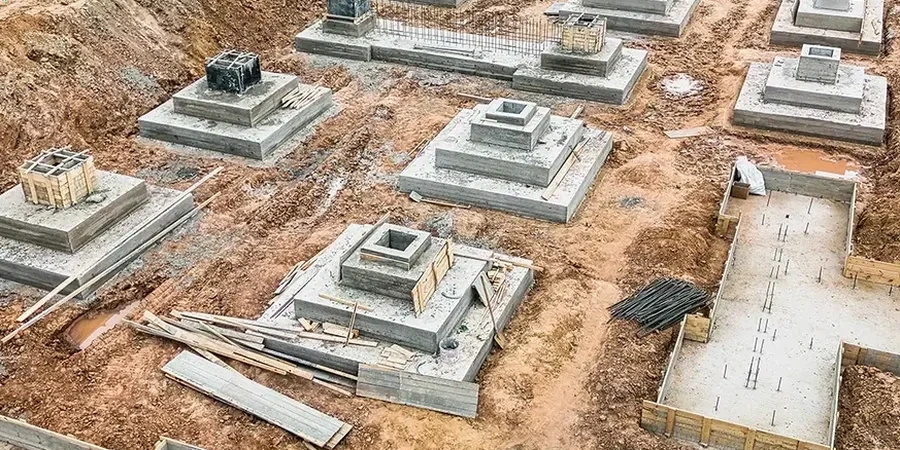
Critical ground factors in Jersey City
Downtown Jersey City and the Greenville section sit on fundamentally different ground, and the risk profile shifts accordingly. Downtown, particularly the Newport and Exchange Place areas, is built largely on hydraulic fill placed over riverbed mud; differential settlement between pile-supported structures and adjacent grade-supported slabs becomes a real concern if the pile group isn't designed with that interaction in mind. Over in Greenville, closer to the Newark Bay side, you're more likely to encounter natural sand deposits that can densify under cyclic loading, but you also run into pockets of organic silt that weren't mapped during the original land surveys. We've seen projects where a pile foundation design that worked perfectly in one neighborhood had to be completely reworked three blocks away because the fill composition changed. The IBC requirement for a geotechnical investigation at each structure isn't bureaucratic overhead; it's what prevents a pile from punching through a lens of material that no one knew was there.
Our services
A pile foundation design in Jersey City spans more than just selecting a pile type and writing a specification. The services we provide cover the full decision chain, from interpreting the geotechnical report to supervising the pile installation program.
Axial capacity analysis and pile selection
We run static capacity calculations using both API and FHWA methods, calibrated against site-specific SPT N-values and lab strength data, and produce a ranked matrix of pile options that balances cost, constructability, and long-term performance under the expected loading.
Lateral load and scour evaluation
For waterfront projects along the Hudson, we model lateral response using p-y curves and account for scour depth per HEC-18, ensuring the pile design remains stable under both service and extreme event conditions including storm surge loading.
Pile driving and testing oversight
We provide field support during installation, including PDA dynamic testing and CAPWAP analysis to confirm capacity, plus documentation that satisfies the special inspection requirements of IBC Chapter 17 without slowing down the contractor's schedule.
Common questions
What does a pile foundation design cost for a typical Jersey City project?
For a standard commercial or multifamily project in Jersey City, the pile design scope generally falls between US$1,470 and US$6,090 depending on the number of piles, the complexity of the subsurface profile, and whether dynamic testing during installation is included. A simple driven-pile layout on a small lot in Journal Square will be on the lower end; a drilled-shaft design for a waterfront tower with lateral load and scour analysis moves toward the upper end. We provide a fixed-scope proposal after reviewing the geotechnical report so there are no surprises.
How does Jersey City's high water table affect pile design?
The groundwater at 4 to 6 feet below grade means the upper portion of any pile is permanently submerged, which eliminates the need for a downdrag analysis from dewatering but introduces corrosion considerations for steel piles in the tidal zone. For drilled shafts, the high water table requires casing or slurry to keep the hole stable during construction, and the design has to account for the reduced effective stress in the upper soils when calculating skin friction.
Do I need pile foundations everywhere in Jersey City, or are there exceptions?
Not every site requires deep foundations. In the higher-elevation areas near the Palisades or on shallow rock, a mat foundation might work. But most of the commercially developed zones, including Downtown, Journal Square, and the Hackensack waterfront, sit on fill and compressible soils where shallow foundations exceed the allowable settlement criteria. The geotechnical investigation will tell you definitively; the pile foundation design follows from that data, not from a blanket assumption.
What pile type works best in historic fill with demolition debris?
Driven steel H-piles and closed-end pipe piles tend to perform best through the cinder, brick, and concrete rubble common in Jersey City fill because they can displace or penetrate obstructions that would collapse an augered hole. Pre-drilling through the fill layer is sometimes used when the debris is particularly dense. Drilled shafts are viable once you're past the fill and into natural soils, but they usually require temporary casing through the debris zone to maintain hole stability. More info.