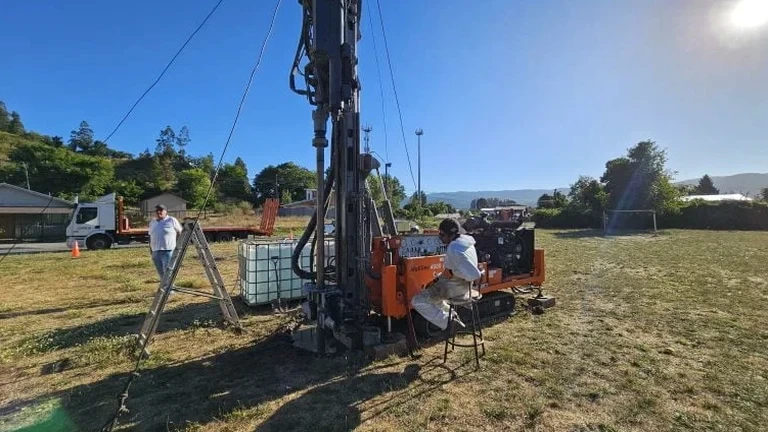
A track excavator positions against the curb on Montgomery Street, bucket teeth cutting through asphalt and into the glacial fill below. That first bucket reveals more about Jersey City’s subsurface than any borehole log can suggest on its own. We run exploratory test pits across Hudson County when the project demands direct observation of soil layers, utility conflicts, or rockhead depth. Unlike rotary drilling, the test pit exposes a vertical face you can walk up to, photograph, and sample by hand. Our field crews have opened pits from Greenville to the Heights, dealing with everything from historic rubble fill to saturated varved clays left by Lake Albany. Each pit gets logged using ASTM D2487 classification, with representative bulk samples bagged for lab work. When a developer near Journal Square needs to confirm old foundation remnants before driving piles, the exploratory test pit answers the question in hours, not days.
In Jersey City’s urban fill, a test pit shows what borings miss – buried foundations, tanks, and rubble zones that dictate foundation redesign.
Service characteristics in Jersey City
- Direct visual logging of strata, fill composition, and obstructions
- Bulk disturbed sampling from each distinct layer per ASTM D2487
- Coordination with utility locates and private mark-out before excavation
- Same-day field logs with photographs and preliminary classification
- Backfill compaction verification when pits are closed as engineered fill
Critical ground factors in Jersey City
Jersey City sits on a mix of estuarine deposits, glacial lake sediments, and a thick mantle of anthropogenic fill that can exceed 15 feet in the old railyard and industrial districts. The fill is unpredictable. We have encountered zones of loose cinder, buried timber matting, and hydrocarbon-stained soil within the same city block. Opening a test pit without proper shoring or benching in these materials risks sidewall collapse, especially below the water table where the varved silt loses strength fast. OSHA Subpart P governs excavation safety, and we apply it strictly on every job. The exploratory test pit also creates a concentrated point of infiltration if left open during rain, which matters in a city where combined sewer overflows can back up into low-lying excavations near the Hackensack riverfront. We manage these risks with sloped walls, pump systems when needed, and backfill placed the same day whenever groundwater is encountered. For sites where the exploratory test pit identifies deep soft clay, we often recommend following up with CPT testing to get continuous sleeve friction and pore pressure data before finalizing foundation elevations.
Our services
Our exploratory test pit work in Jersey City typically includes a suite of supporting field and lab services that turn a visual observation into a defensible geotechnical dataset.
SPT Drilling Coordination
We pair test pits with adjacent SPT borings to correlate visual stratigraphy with N-values, particularly useful where fill thickness varies sharply across a site.
Grain-Size Distribution
Bulk samples from each pit layer are sieved to produce full gradation curves per ASTM D6913, giving the design team quantitative soil classification beyond field visual estimates.
Infiltration Testing
When stormwater management is part of the project, we run in-situ permeability tests in the pit bottom to measure infiltration rates in the native soil below the fill zone.
Common questions
How deep can you excavate a test pit in Jersey City?
Most pits in the area reach 10 to 15 feet with a standard track excavator. Deeper excavations require benched or sloped walls per OSHA, and groundwater often limits depth in the low-lying areas near the Hackensack and Hudson rivers.
What does an exploratory test pit cost in Jersey City?
A single exploratory test pit with field logging, photography, and bulk sampling typically runs between US$560 and US$760, depending on depth, access constraints, and whether utility locates require private mark-out beyond NJ One Call.
Do you need a permit to open a test pit in Jersey City?
Permit requirements depend on the location and depth. Work within the public right-of-way requires a street opening permit from the city. Private property work generally does not, but we always call NJ One Call and coordinate with the site owner for any private utility mark-out before excavation.
How do you backfill the pit after the investigation?
We backfill in compacted lifts using the excavated material when it is suitable, or with imported engineered fill if the native soil is contaminated or too wet. Each lift gets density testing when the specification requires it, and the surface is restored to match existing grade. More info.